 Derpdex
 swap results, reversibility, and liquidity exits
Derpdex swap results require checking the executed exchange and recipient balances, while liquidity exits also require checking the position. A confirmed swap has no cancellation step. Removing liquidity follows a different mechanism: the position's remaining liquidity and collectible assets determine whether an exit still needs another action.
Completed exchange or remaining liquidity position
The next action depends on whether the assets already reached a wallet or remain represented by a liquidity position. Tokens received through a completed swap require a new transaction to exchange again. A liquidity position requires its own withdrawal mechanism. Derpdex uses a router for swaps and an NFT position manager for individual liquidity positions. If the position's network, manager, or ownership is unknown, that missing information prevents choosing a reliable withdrawal action.
Can a confirmed swap be reversed?
A completed swap cannot be cancelled through a later wallet action; exchanging back requires a separate trade. That trade uses the liquidity and pricing available when it executes. It doesn't restore the original transaction or refund its costs.
Before submission, rejecting the wallet request prevents that request from proceeding. After broadcast, a pending label doesn't establish whether cancellation remains possible. Replacement behavior depends on the network and wallet, and an attempted cancellation can lose the race against execution. Closing a browser tab doesn't withdraw a signed transaction from the network. Once execution becomes final, the transaction remains part of the chain's history.
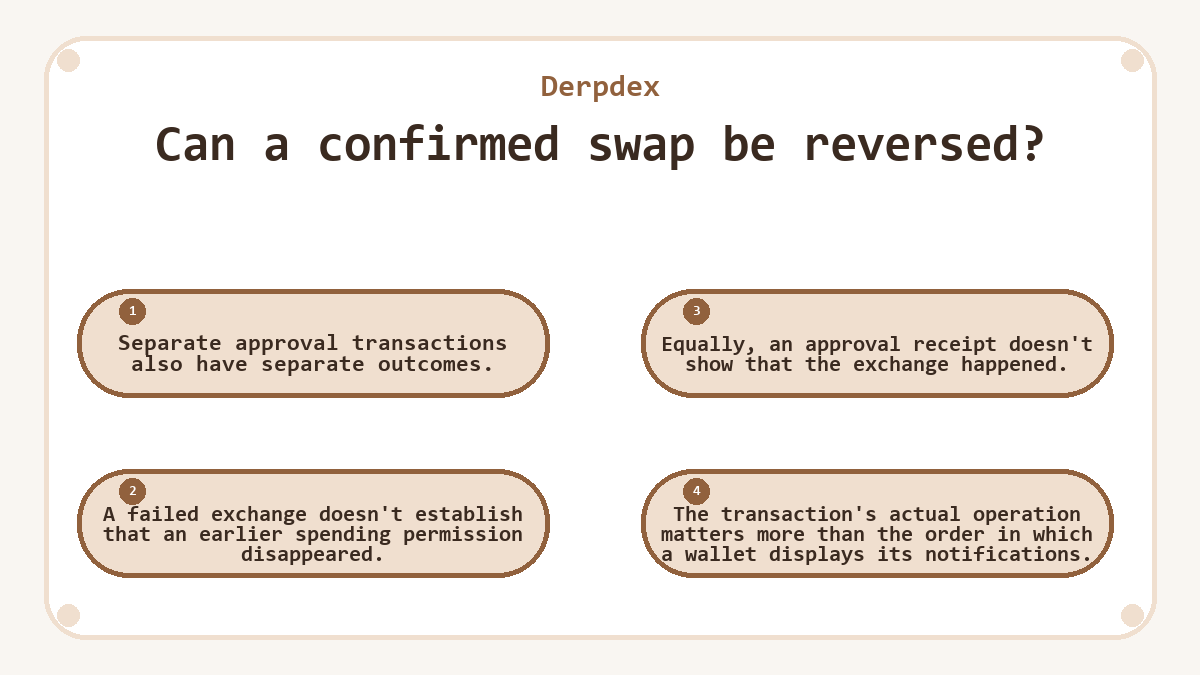
Separate approval transactions also have separate outcomes. A failed exchange doesn't establish that an earlier spending permission disappeared. Equally, an approval receipt doesn't show that the exchange happened. The transaction's actual operation matters more than the order in which a wallet displays its notifications.
What proves that the swap completed?
A swap is complete when the executed transaction and resulting asset movements match the intended exchange and recipient.
Receipt and executed operation
A transaction hash identifies a submitted transaction; its receipt records execution after inclusion. Match the sender, destination contract, and network before interpreting its status. A successful receipt for an approval establishes permission, not receipt of the purchased token. The swap has its own execution record, even when an interface presents both operations as one activity. Retaining the transaction hash makes that distinction easier to recover after the interface session ends.
For command-based router transactions, inspect the commands that actually completed. Derpdex's Universal Router supports a flag that allows an individual command to fail without reverting the entire transaction. This applies when the submitted transaction uses that router and enables the flag. A successful outer transaction therefore doesn't, by itself, establish that every intended swap command succeeded. If a swap command failed, also check whether unused input tokens remained in the router.
Recipient and asset movements
Compare the executed input and output transfers using token contract addresses, rather than symbols alone. The recipient encoded in the transaction can differ from the signing wallet. For reconciliation, isolate the transaction's movements from unrelated transfers that changed the balance afterward. A present wallet balance answers what the account holds now; transaction records explain what the exchange delivered.
Keep swap fees and network charges separate when comparing results. The network charge pays for execution and can affect a different balance from the traded tokens. A quote describes proposed execution under particular conditions. The receipt, transfers, and resulting balances describe the exchange that happened. A difference requires explaining those conditions, rather than treating the earlier quote as an additional balance owed.
Liquidity reduction and token collection
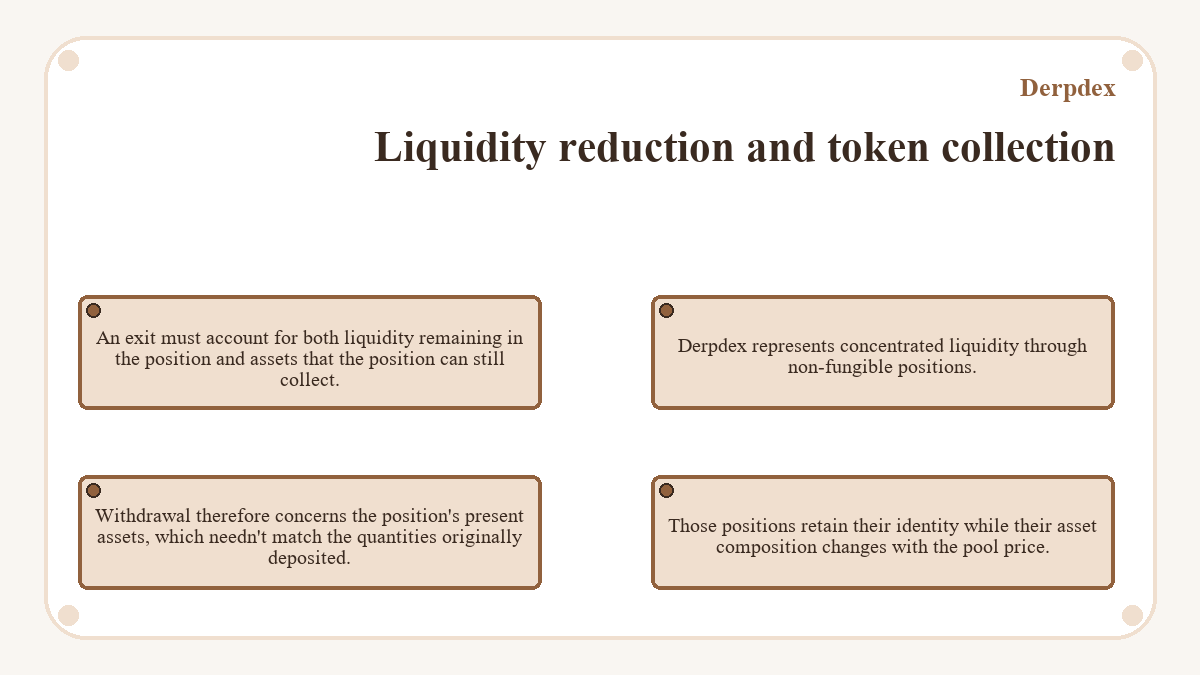
An exit must account for both liquidity remaining in the position and assets that the position can still collect. Derpdex represents concentrated liquidity through non-fungible positions. Those positions retain their identity while their asset composition changes with the pool price. Withdrawal therefore concerns the position's present assets, which needn't match the quantities originally deposited.
Reducing the position
For a position that uses the V3 position-manager interface, decreaseLiquidity reduces its liquidity and accounts for the underlying token amounts owed. Its parameters include the position identifier, liquidity amount, minimum token amounts, and deadline. Those conditions govern execution; they aren't interchangeable with a wallet's displayed deposit value. A partial reduction leaves liquidity in the position. Use this interpretation only where the deployed manager implements that interface.
Collecting the proceeds
In the V3 position-manager interface, reducing liquidity and collecting the resulting tokens are separate operations.
The collect operation sends collectible amounts to its specified recipient, subject to its collection limits. A compatible transaction may bundle reduction and collection, so separate operations don't necessarily mean separate wallet submissions. The relevant evidence is the remaining position state and actual token delivery.
A position with no remaining liquidity can still have amounts awaiting collection. Conversely, collecting accrued fees can leave the liquidity allocation intact. Transferring the position NFT changes ownership; it doesn't itself convert the underlying position into wallet tokens. These distinctions explain why a successful transaction or a changed NFT display can coexist with an unfinished exit.
Can you exit if the interface won't load?
An unavailable interface doesn't establish whether withdrawal is possible; the answer depends on the deployed contracts and your position's authorization.
For an existing position with no usable interface, compare interface access and direct contract access against the same requirements: position identity, authority, transaction parameters, and destination. An interface can prepare those parameters. Direct interaction requires understanding the deployed contract's callable interface, including any intermediary that holds the position. Neither approach supplies missing ownership rights.
- If the position identifier or manager is missing, recover that relationship from the original deposit and NFT transfer records before preparing a withdrawal.
- If the recorded owner differs from your wallet, establish how that owner authorizes withdrawals before attempting a manager call.
- If the manager implements separate reduction and collection, determine whether liquidity remains, collectible amounts remain, or both.
- If the proposed transaction's recipient or minimum amounts are unclear, resolve those parameters before signing.
- After execution, match the resulting position state and recipient transfers to the intended partial or complete exit.
A generic token transfer function doesn't substitute for removing a liquidity position. An explorer can expose callable functions without explaining which one fits the account's holdings. If the position belongs to an intermediary contract, its withdrawal rules become a prerequisite. An old deposit record alone doesn't prove that your wallet currently controls the NFT.
Reconciling the exit before moving assets again
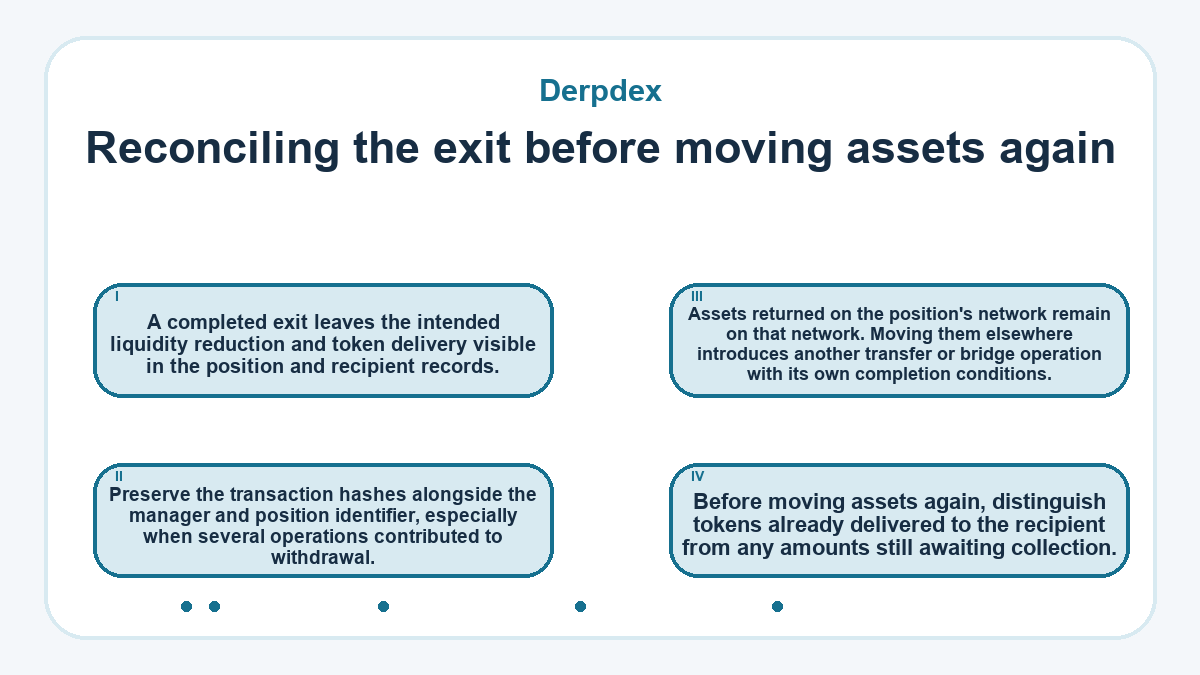
A completed exit leaves the intended liquidity reduction and token delivery visible in the position and recipient records. Preserve the transaction hashes alongside the manager and position identifier, especially when several operations contributed to withdrawal. Assets returned on the position's network remain on that network. Moving them elsewhere introduces another transfer or bridge operation with its own completion conditions. Before moving assets again, distinguish tokens already delivered to the recipient from any amounts still awaiting collection.
Derpdex: quick answers
-
Why does my liquidity NFT remain visible after a withdrawal?
- A visible NFT doesn't necessarily mean that liquidity remains invested. For positions using the V3 manager interface, removing liquidity, collecting tokens, and burning the empty NFT are distinct operations. Burning requires the position to have no liquidity or collectible tokens remaining. The position's state determines whether funds remain, rather than the continued appearance of its image.
-
Does a successful simulation guarantee that a liquidity exit will execute?
- A successful simulation doesn't guarantee execution under later conditions. It evaluates the proposed call against the state used for that simulation. Pool conditions, authorization, or a transaction deadline can differ before inclusion. Simulation can help identify a failing call, but the executed transaction and resulting position state establish what the withdrawal accomplished.
-
What information can I share when investigating a missing withdrawal?
- The network, transaction hash, public wallet address, and position identifier can help someone inspect a withdrawal without receiving signing authority. Sharing them can link your identity to public transaction history. A seed phrase or private key isn't needed to inspect those records and would give another person control over the associated wallet.
-
Must an out-of-range position return to its range before I can withdraw?
- Being outside the trading range doesn't itself impose a withdrawal lock on a standard V3 liquidity position. It changes the underlying asset composition, potentially leaving the position entirely in one pool asset. Withdrawal still depends on authorization and the applicable contract conditions. A separate contract holding the position can impose additional restrictions.
-
Can I change the collection recipient after the tokens have arrived?
- An executed collection can't be edited to substitute another recipient. Moving the delivered tokens requires a new transfer authorized by the account that received them. If another contract received the tokens, its own callable functions and permissions determine whether they can move again; a successful collection doesn't establish that your wallet controls that recipient.
-
What happens to my position if a withdrawal deadline expires?
- For a V3 manager call with an enforced deadline, execution after that deadline reverts instead of reducing liquidity. The expired deadline belongs to that attempted transaction; it doesn't itself expire the position. Earlier successful transactions retain their effects, but a reverted transaction rolls back the position changes made within it. Check the position's present state before preparing another withdrawal.