 Derpdex
 concentrated liquidity participates in swaps within a selected price range
Derpdex concentrated liquidity earns new swap fees when the pool trades through an active position's selected price range. Outside that range, its principal consists of one asset and stops earning new swap fees. To determine whether a position is active, compare its recorded boundaries with the pool's current tick, and confirm that the position still contains liquidity. A tick identifies a point on the pool's price scale. An unchanged fee balance, a rounded price, or a missing position display doesn't establish the same condition. Each observation needs a different check before you consider adding funds or changing the range.
Bottom line: A position's recorded bounds and the pool's current tick determine range status; an unchanged fee balance alone doesn't explain inactivity.
In range, inactive, and missing describe different states
An in-range position has boundaries that contain the pool's current tick. It also needs a positive liquidity balance to participate in swaps. A position can retain its identifying record after its liquidity reaches zero, so a visible position alone doesn't prove that capital remains active.
Out of range describes the relationship between price and the selected boundaries. Missing describes a problem finding or displaying the position. Those observations call for different investigations: the former requires comparing the current tick with the selected boundaries, while the latter requires checking the network, position manager, and position identifier. Neither observation, by itself, proves that assets have disappeared.
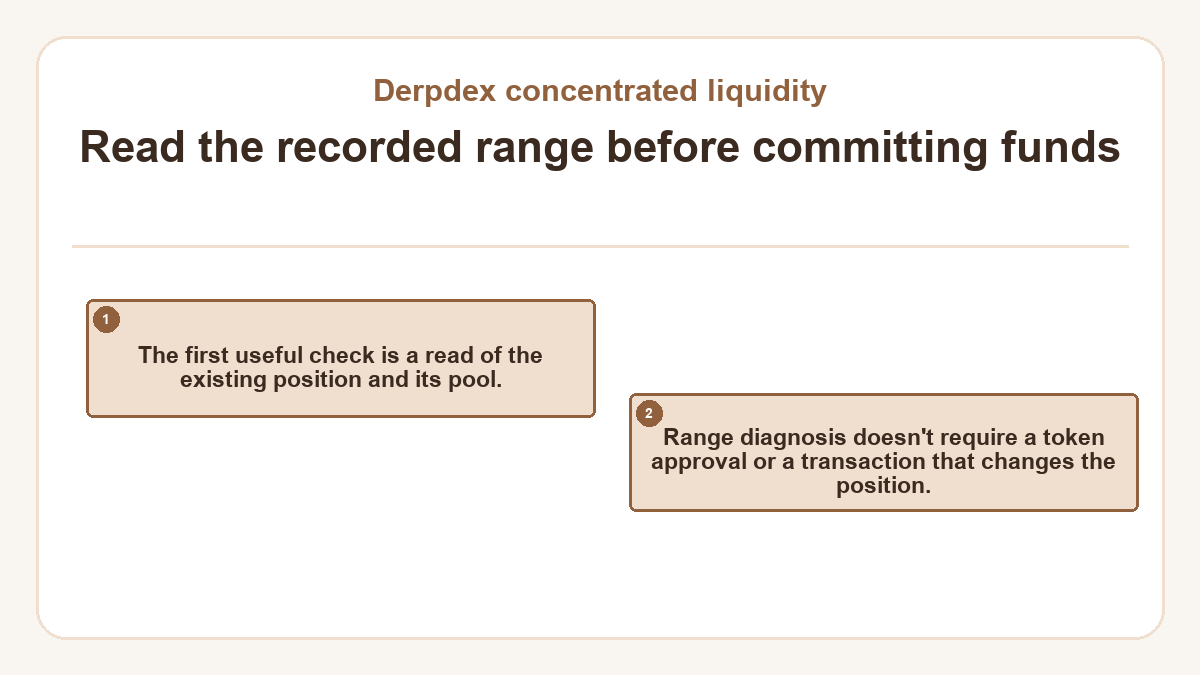
Read the recorded range before committing funds
The first useful check is a read of the existing position and its pool. Range diagnosis doesn't require a token approval or a transaction that changes the position.
The position record identifies its assets, pool fee, lower boundary, upper boundary, and liquidity amount. These details distinguish positions that might otherwise share the same pair name. The position identifier belongs to a particular position manager on a particular network; an identifier without that context isn't enough.
Read the pool's current state alongside the position details. Comparing values from different blocks can create an apparent contradiction when a swap crosses a boundary between reads. Keep the block reference with the values, particularly when the price sits close to an endpoint.
For a planned first deposit, the proposed range and token amounts describe an intention. The recorded position describes what exists after execution. A completed approval doesn't establish either an active deposit or a particular range, and a preview can't promise that price will remain inside the boundaries.
Match the price direction before comparing bounds
Price comparisons require the same asset order on both sides. A displayed price states how much of one asset corresponds to the other; reversing that order changes the numerical comparison.
Asset order and the price scale
The pool records its assets as token0 and token1. Those labels describe contract ordering, not which asset you prefer to hold. A human-readable price also needs the assets' decimal scales. Comparing a raw contract value with a formatted price can therefore produce a false range mismatch.
Price below the selected interval
In the pool's token1-per-token0 price direction, principal below the lower boundary consists of token0. The position waits outside the active interval.
Price above the selected interval
Above the upper boundary in that same direction, principal consists of token1. Reversing the displayed quote reverses the apparent high and low sides.
Principal and previously earned fees
The single-asset description concerns the principal represented by the liquidity position. Previously earned fees are separate accounting amounts. A display that combines principal and collectible fees can therefore show both assets even when the principal has moved entirely to one side. Read those components separately before treating the balance as evidence of incorrect range status.
Why can an in-range position show no new fees?
An in-range position needs fee-generating swaps through its liquidity before its earnings increase. Time spent inside the boundaries doesn't create a fixed payment, and a quiet pool can leave the displayed balance unchanged.
Fee income also depends on the position's share of active liquidity where the swap occurs. The fee that the pool charges isn't the amount that each provider receives. Other active positions share those fees, and a small accrued amount may disappear behind display rounding. A fee estimate therefore answers a different question from a direct range check.
Previously accrued fees can remain collectible during inactivity. Their presence doesn't show that the position is earning new fees now.
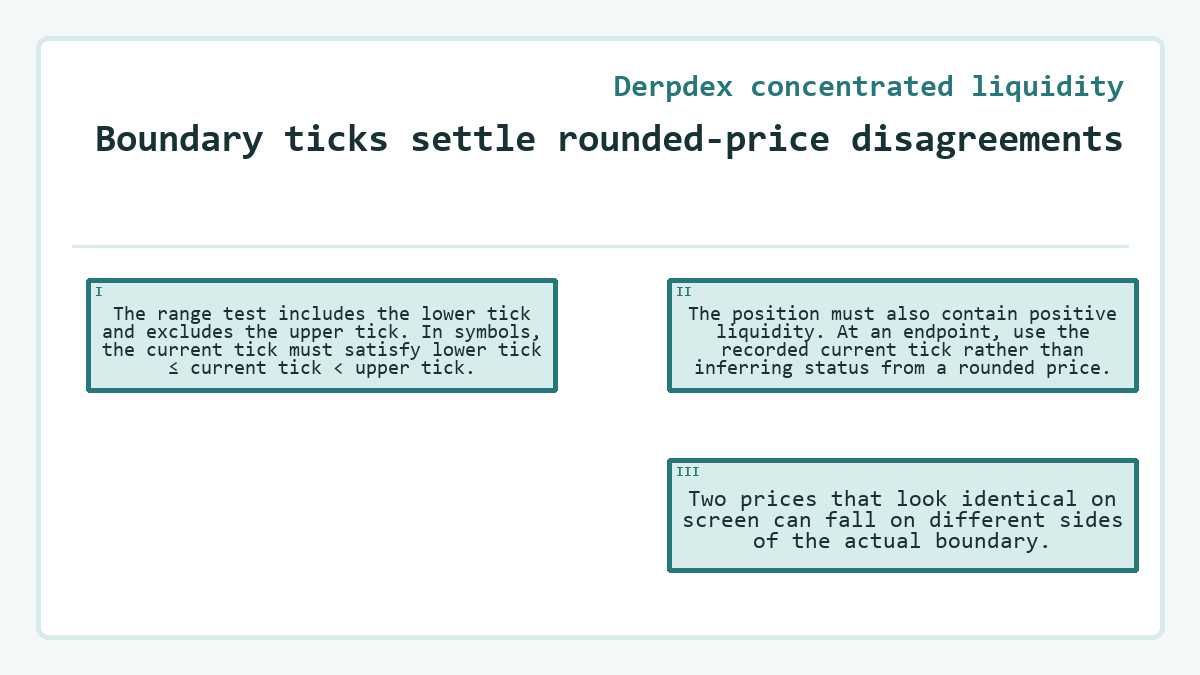
Boundary ticks settle rounded-price disagreements
The range test includes the lower tick and excludes the upper tick. In symbols, the current tick must satisfy lower tick ≤ current tick < upper tick. The position must also contain positive liquidity. At an endpoint, use the recorded current tick rather than inferring status from a rounded price. Two prices that look identical on screen can fall on different sides of the actual boundary.
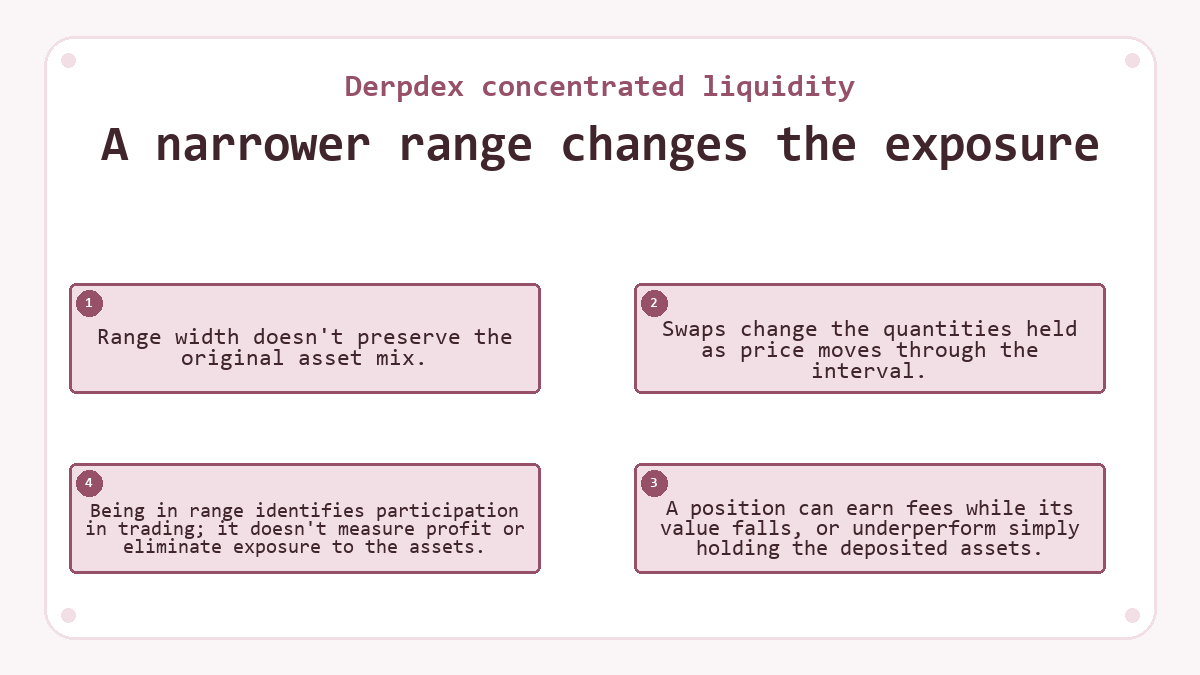
A narrower range changes the exposure
A narrower interval concentrates capital around fewer prices. For the same capital and a price inside both candidate ranges, narrowing the interval can increase the liquidity available locally. It also brings a boundary closer, so a smaller price movement can make the position inactive.
Range width doesn't preserve the original asset mix. Swaps change the quantities held as price moves through the interval. A position can earn fees while its value falls, or underperform simply holding the deposited assets. Being in range identifies participation in trading; it doesn't measure profit or eliminate exposure to the assets.
Valid endpoints also depend on tick spacing, which determines the permitted boundary increments for the pool. An arbitrary typed price may not correspond to a usable endpoint. Compare the resulting boundaries, rather than assuming that a rounded input became the exact recorded range.
A missing interface leaves range status unresolved
An unavailable interface supplies no direct evidence about the pool's current tick or the position's liquidity balance. Public contract reads can establish those values when the correct network and contracts are known. Reading a position and preparing a withdrawal are separate tasks with different prerequisites. If you can't identify the position manager or match the position to its pool, stop before submitting a contract transaction. A guessed transfer operation doesn't diagnose range status.
Waiting for re-entry or preparing another range
Leaving a funded position unchanged preserves its existing boundaries. Its liquidity can become active again if the pool price re-enters the interval. That condition has no promised arrival time, and the remaining asset continues to carry price exposure while the position waits.
Allocating liquidity to another interval changes where the capital participates. It requires suitable asset amounts for the new range and the state at execution. Network transaction costs and any asset exchange needed for that allocation affect the decision. Collecting old fees alone doesn't relocate the boundaries.
The relevant comparison is the exposure you retain while waiting against the exposure and costs of another allocation. A wider interval covers more prices, but it can't guarantee trading activity or sufficient fees to offset those costs.
Confirm the mismatch before changing a position
Suppose a funded position appears inactive even though you expected it to include the pool price. The available choices are to retain its existing range or prepare a different allocation. Both choices require the same starting information: the correct position, readable pool state, and a consistent price direction.
Begin with the read-only comparison. If matching records show that the current tick lies outside the position, the observed inactivity fits the range rule. If the tick lies inside and liquidity is positive, refresh the display and investigate fee activity before treating a range change as a repair.
The boundary rule is durable; the current tick is live state. A later read can legitimately produce a different status.
- If the network, manager, or position identifier doesn't match, resolve that mismatch before preparing a transaction.
- If the price and boundaries use different asset orders, put them on the same scale before comparing them.
- If liquidity is positive and the tick lies outside the interval, decide whether retaining the resulting asset exposure fits your intended allocation.
- If you prepare another range, check its valid endpoints, required assets, permissions, and transaction costs before signing.
- If a range allocation executes, confirm the recorded boundaries and liquidity against the resulting pool state before adding further funds.
A transaction can establish the intended position even if subsequent price movement makes it inactive. Confirm what executed, then decide whether to retain that allocation. If ownership or contract details remain unresolved, stop before signing.
Common questions about Derpdex concentrated liquidity
Can two Derpdex positions in the same pair have different range statuses?
Two positions in the same pair can have different statuses because each has its own boundaries. Positions may also belong to separate pools with different fees and price states. Compare each position with its own pool rather than applying one pair-level price or status label to every position.
Does adding liquidity to an existing position widen its range?
Adding liquidity to an existing position increases its allocation within the existing boundaries. It doesn't make an out-of-range interval include the current price. Capital intended for different boundaries needs a position with those boundaries, rather than a larger balance in the unchanged interval.
Will collecting swap fees automatically compound my concentrated liquidity?
Collecting swap fees doesn't automatically add them to the position's liquidity. Collection and reinvestment are separate operations. Increasing the position requires suitable asset amounts for its range and the pool price at execution; collectible fees alone don't establish that those amounts are ready.
Why doesn't the pool's total token balance show liquidity available at my range?
A pool's total token balance includes assets associated with positions across different price intervals. Only liquidity active at the relevant price participates there. Total balances therefore can't establish your position's status or the amount of liquidity that competes with it for fees.
Do chart candles prove that my position stayed in range between checks?
Chart candles don't necessarily show every boundary crossing in the position's own pool. Their sampling interval, price source, and asset orientation matter. A current status read establishes the position's state at that block; it doesn't reconstruct all trading that occurred between earlier observations.